Heute Morgen habe ich mich in der 70cm-Klasse versucht.
Diesen UKW-Kontest kann man in die Klasse „muss man nicht mitgemacht haben“ einorden. Das Band war tot. Nicht einmal irgendwo war eine leise Station zu hören. Habe etwa 15 Minuten CQ gerufen: nichts. Dann hörte ich Wolfgang, DK1HW/p, wie in SOTAwatch angekündigt, auf dem Köterberg. Auch auf dem Köterberg war noch DB1AI/p.
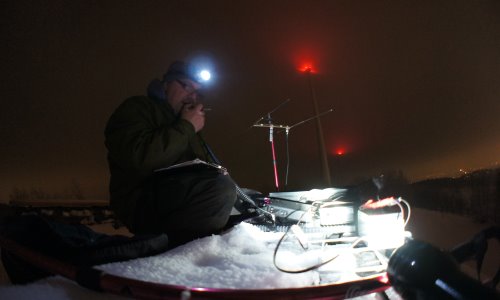
WNA is the North-Westphalia Activation evening. This 2 hour 2m/70cm FM CW SSB contest is held on every first tuesday in a month. I started this evening at 1845 UTC and called CQ on 70cm SSB.
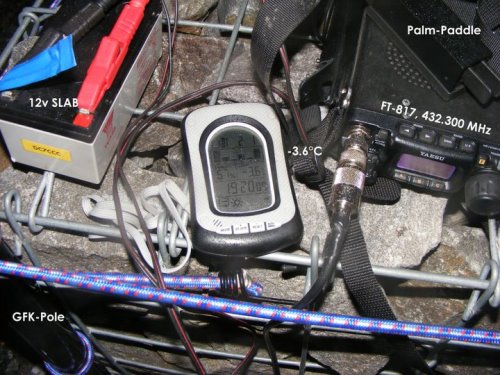
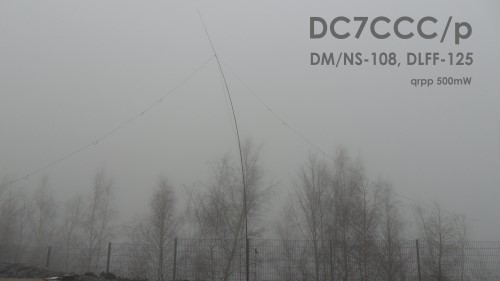
Setup
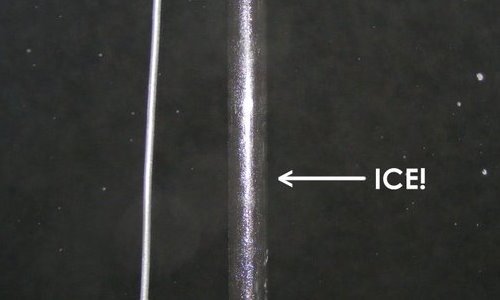
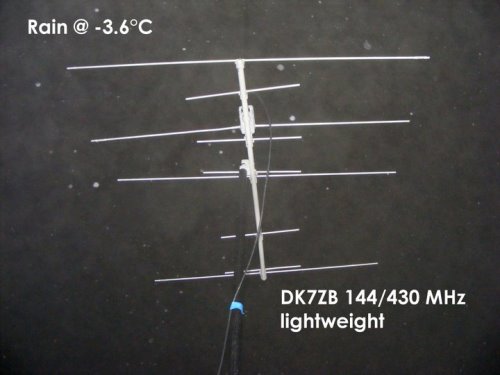
But no answer. Then suddenly rains started at -3.6°C (26°F). Quick I made some QSO on 2m and after another 15 minutes I made qrt. The ice on the mast was very thick, I could not push it together. I discovered a new usefull tool for the outdoor HAM. The hot tea was this evening not for the Operator but for the GFK-pole.
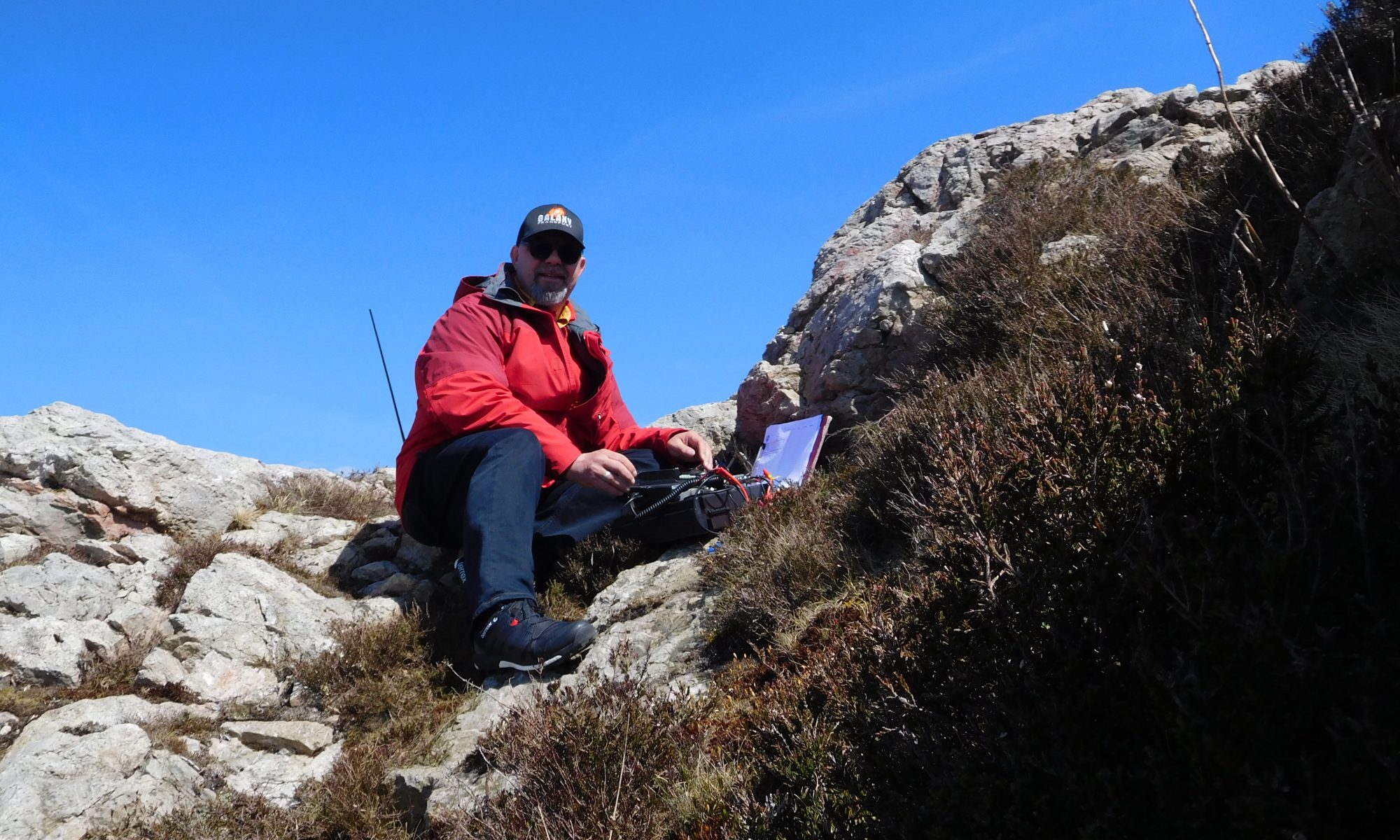
Bei Minustemperaturen ging es heute Abend auf den Piesberg (DM/NS-108). Aber es war nicht zu kalt. Die Felsrippe war schnell erreicht und die Station aufgebaut. Im 70cm SSB Bereich war keine einzige Station zu hören. So rief ich CQ. Ungefähr eine Viertelstunde blieb ich ungehört. Leider. Plötzlich setzte Regen ein, aber ich wollte noch wenigstens 4 QSO auf 2m machen. In der folgenden Viertelstunde sind neun QSO daraus geworden, dann merkte ich, wie der GFK-Antennenmast vereiste und ich machte mir Sorgen, ob ich den überhaupt wieder zusammenschieben kann. ALso schnell QRT gemacht, die Antenne abmontiert – und dann bewahrheiteten sich meine
DK7ZB Antenna in the freezing rain
Befürchtungen. Durch das Eis ließ sich der Mast nicht vollständig zusammenschieben. Aber zum Glück hatte ich eine Thermoskanne mit heißem Tee dabei! Damit habe ich die Verbindungsstellen der einzelnen Mastelemente übergossen und dann konnte ich den Mast zusammenschieben.
Der Abstieg gestaltete sich als äußerst schwierig; denn auch der geschotterte Wanderweg war spiegelglatt. Ganz abgesehen von den Treppen und dem kleinen Stück asphaltierter Straße auf der Felsrippe. Nach knapp einer Stunde war ich am Auto, das dann auch erstmal vom Eispanzer befreit werden wollte.
Der NAC ist der „Nordic Activity Contest“, der WNA ist der „Westfalen Nord Aktivitätsabend“. Auch im Baltikum finden zur gleichen Zeit Aktivitätsabende statt, sodass das Stationsangebot recht gut ist. Zeitpunkt ist immer der erste Dienstag im Monat (NAC nur 144 MHz, 432 MHz am 2. Dienstag im Monat).
Beide Wettbewerbe starten 19.00 Uhr Küchenzeit. Beim WNA geht es um „N-DOKs“ von Bielefeld bis Münster und noch südlich davon. Austausch ist hier Rapport + DOK (z.B. bei mir: 55 D23). Der WNA findet auf 2m und 70cm statt. CW SSB FM.
Etliche OZs haben ein sehr starkes Signal hier im Nordwesten (DM/NS). Aber auch Stationen aus SM sind nicht selten, sowie ON und F, für den NAC. Austausch Rapport + lfd Nummer (z.B. bei mir: 57 JO42AH)
for a good performance I used a dipole instead the MP-1 with the Rockmite Transceiver
On 29th December 2010 reached me the Rockmite 40 kit. I build it up and on 22nd January I made my first SOTA Operation with the Rockmite in the classic peppermint case. The transceiver has 500mW output and I worked 6 stations from LA, DL, G & F with fog, drizzle and temperature about 0°C.
Am 29. Dezember 2010 traf nach ca. einem Monat der Rockmite Bausatz aus den USA ein. Beim Zoll musste ich noch 6,91€ Umsatzsteuer
The Rockmite 40 Kit
bezahlen und dann habe ich meinen Bausatz und einen ganzen Stapel Papiere mit vielen Stempeln und Unterschriften erhalten.
Der Aufbau war zwar ein bisschen fummelig, aber die Platine war tatsächlich an einem Abend bestückt. Jedoch fehlte ein Kondensator im Bausatz und ich musste bis zum neuen Jahr 2011
after one evening work
warten, um mir einen Kondensator aus dem Electronic Shop zu besorgen.
Nachdem dann der Kondensator eingesetzt war, konnte am 4. Januar der „Smoke Test“ stattfinden. Zu meiner Überraschung funktionierte der Empfänger sofort und ich hörte eine Italienische Station CQ rufen. Aber auch der Sender funktionierte.
Smoketest: all okay!
Den Transceiver wollte ich nun in eine klassisches Altoids-Pfefferminzdose einbauen. Die hatte ich schon seit 2 Jahren in einer Schublade liegen. Auch dieser Arbeitsgang dauerte etwa einen Abend, dann war das selbstgebaute Funkgerät fertig.
Klar, jetzt wird jeder erstmal fragen, was will man mit 500mW auf 40m ausrichten?
Build into a Peppermint-Case
Die Antwort gab es heute. Bei Schmuddelwetter und Temperaturen um den Gefrierpunkt bin ich auf den Piesberg gestiegen. Anstatt der MP-1 Antenne habe ich heute lieber einen Dipol ghenommen, der sicher eine bessere Performance hat. Nach kurzem CQ und einem Spot auf SOTAwatch.org meldete sich auch schon Alain, F6ENO. Schnell darauf meldeten sich auch noch DL3JPN, G3VXJ, F6CEL, G4ELZ und LA1ENA.
The finished Rockmite Transceiver
Der Run dauerte nur 5 Minuten. Der Nieselregen kroch aber langsam unter die Jacke und bevor die Elektronik Schaden erleiden würde, habe ich beschlossen QRT zu machen.
Einen ausgiebigen Rockmite Test werde ich dann nochmal bei schönem Wetter durchführen.
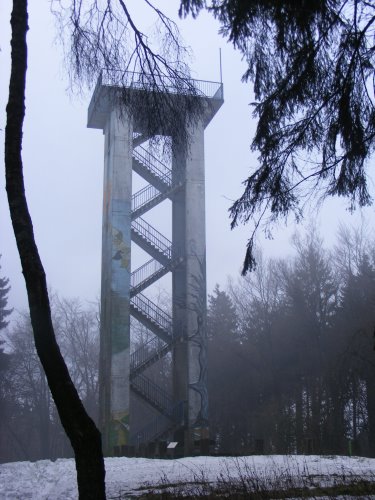
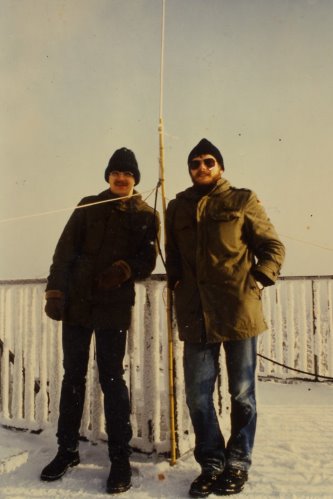
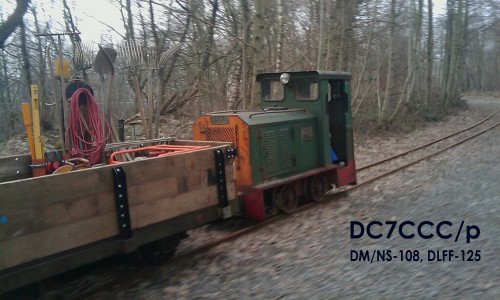
HermannsturmOperating Site on the PlatformGood Old Times: same location in 1985 10m Contest at -15°C. Left DL4BAH (now DC7CCC), right DL5BAD as DFØJU/p
No Conditions are Good Conditions
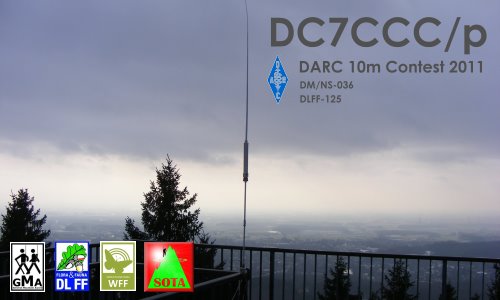
One of my favorite contests ever is the DARC 10m Contest. In the80’s several times per year it is reduced to only one date: The January DARC 10m Contest. Mostly there are bad conditions, two years ago I worked stations from Italy or Spain during the contest. But today the band was closed. This is a big advantage for the radio-hiker on the summit: No DX condition means, that the high-power stations with beams can work also over groundwave only.
My station today: about 20w output into my MP-1 antenna. Temperatures on the tower around 0°C, no rain or snow. So I decided to operate directly from the platform. I started 10 minutes too late, because the ascent on the „Dörenberg“ was very difficult. Crusted snow and ice-fields forced me to go very slow. A normal ascent takes 20-25 minutes, now I needed 1 hour. On the top of the summit were 30cm crusted snow, but the tower was luckily free of snow and ice.
The first call was at 09:11 UTC and was followed by the first answer. Until 10:59 I logged 117 QSO. This year SSB only. CW is in this contest a waste of time except you are in the CW class only.
Only one group hikers visitied the tower today. After the first hour of the contest wind came up … the last 30 minutes the windchill gave me a -20°C feeling. I was glad when the contest ended and I left the tower quickly. I cancelled also the planned additional 40m SOTA operation.
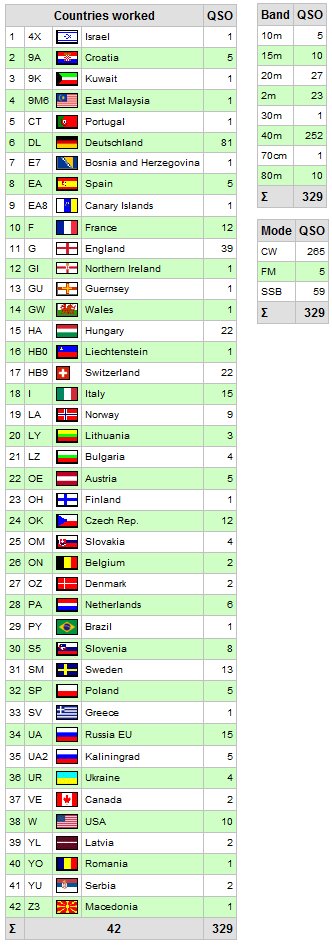
Results: 117 QSO, 1 DXCC, 58 DOKs = claimed score 6903 points. I hope it won’t give too much deduction of the points. Some stations had problems with DC7CC and DL7CCC and DC7CCC 🙂
December "Westfalen Nord" Activity EveningCo-Operator Anton
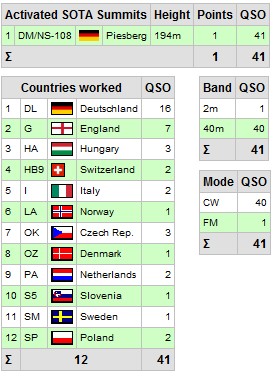
I continued operations from DM/NS-108 through November 2010 and continue during December 2010 … but now in snow. Last Saturday, 4th December, it was very cold. We wanted to make a handful QSO only but then a pile up started and after 30 minutes were 40 stations in the log. My first CW activation operating with gloves. ICECOLD! stn: 5w, MP-1, 7MHz only
Yesterday at WNA / SAC my ball pen failed … it was empty. I made only 5 qso, that was the maximum brain-storage yesterday 😉
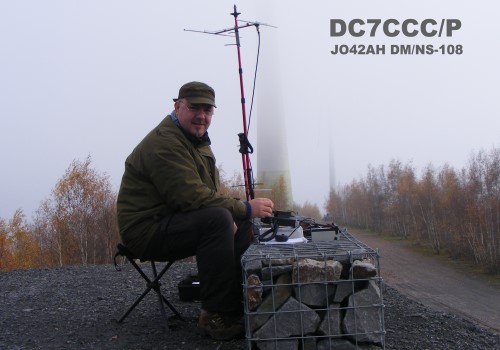
This weekend was the Marconi Memorial CW Contest on 144 MHz. I wanted to take the chance to work some stations in CW on 2m this morning. I was one hour qrv during a walk over NS-108 Piesberg. It was my first participation in this contest since I am licensed (1978). I heard a lot of stations but mostly with low signals. In spite of my qrp station ( 5 wtts / HB9CV) I worked new ODX from DM/NS-108:
TM0W in JN36BP 645km
OK2M in JN69UN 501km
OK1DC in JN69JJ 465km
I heard some stations far far away like OM7W (885 km), but no chance to work them (today).
This contest is for everyone, at home, in your car, in the field. Any mode , CW , SSB , FM or digital modes. Any band or Satellite. Support your friends in the field, you never know, you may work a really rare grid in the process!
Time: 12:00 UTC – 18:00 UTC
Please see the „Blue book“ , SARL Forum or on www.nwinternet.za.org/zs6bne/RaDAR for contest details. Please use the logbook format available as links on the websites.
The true RaDAR station must have carried the entire station including antennas for at least 1 km prior to setting up, without relying on existing man made infrastructures i.e. antennas, masts or towers.
To be considered as a RaDAR station, the entire station; radios, batteries, mast and antennas must be easily portable and hence the need to carry the equipment for at least 1 km
Diese Seite verwendet Cookies, um die Nutzerfreundlichkeit zu verbessern. Mit der weiteren Verwendung stimmst du dem zu.